
American Intelligence

I could feel my manhood slowly leave my body as my dad asked my new wife, not me, to grab the Allen wrench and help him fix a table we were building. I’m ashamed to admit it, but my Dad was right. My wife was handier than I was. I’ve always been the absent-minded professor… smart in school but bordering on Forrest Gump levels of troglodyte IQ when it came to having common sense or fixing things around the house.
Then AI came along and now I’m Mr. Fix-It. Air conditioner broken? Don’t worry honey, I got this. Netflix stopped streaming? On it. Toilet clogged? All my problems flushed away!
I voice note the demands insensitively into the latent space of all knowledge… “Chat, I’m about to send you a bunch of photos of a broken air conditioner unit. I have no idea how to fix it. It started dripping a few minutes ago. Fix it now!
ChatGPT: I can see the unit perfectly, it is a 2897 UnitA. To fix it [ChatGPT continues to answer for 3 more seconds, but it’s already taking too long and I don’t have the patience]
I interrupt rudely. I yell “No, you are taking too long, I don’t want to read all that! Assume I’m an extremely dumb 10-year-old with the IQ of a wet carrot. Tell me step by step EXACTLY what to do. Make no mistakes.”
ChatGPT immediately: “Step 1: Unplug the outlet. Step 2: Click big red button…. Step X: Fixed.
Suddenly I fixed something in 3 minutes that I would have spent an hour unsuccessfully trying to fix myself before I shell out $500 to some dude. I’d probably have to talk to some customer support person to get the appointment booked beforehand, yell at them because I’m frustrated, apologize for being rude afterwards because I felt bad that I yelled, and wait a bunch of days for the person to actually come out there and maybe fix the damn thing. Instead, I got my manhood back for a $20/month subscription.
It sounds dumb, but that feeling of transforming into a more useful version of myself … of having this little robot helper buddy just aid me along the way… it truly felt like a super power. I was a new me. A better me. Before I was a useless dumbass whose Dad entrusted his daughter- in law instead of his own son to help him build something with his hands. Now I’m the man around the house who fixes shit for my wife.
That upgrade in self-worth is priceless. I mean this sincerely in that feeling so much more useful without needing help from any other person, just a little help from my robot friend, was penicillin for my soul. I don’t think I’m alone here in saying that feeling useful, having a purpose, of feeling a direct instead of derivative impact on your work, and of accomplishing a mission, especially without the concomitant judgment that inevitably comes from a human helping you get there, is a nutrient-rich development for one’s own sense of agency, of finding and enriching your soul. AI will soon be the most nutrient rich substance for your soul on Earth.

In the 1999 film Office Space, a software company hires two consultants — both named Bob — to decide who gets cut. One by one, employees sit across the table while the Bobs ask a single, lethal question: "What would you say you do here?" The movie's most famous victim, Tom Smykowski, can't answer it. His job is to take the specifications from the customers and bring them to the engineers — that's the whole job — and as the Bobs press, his voice climbs into panic until he's shouting defensively that he's a “people person! I talk to the customers so the engineers don’t have to! I’m a people person! Don’t you get that!? What’s wrong with you people?!”
The scene became a meme because everyone recognized it: not the absurdity of Tom's job, but the dread of the question. Tom’s sincere and worried grasping for a defensible answer to the Bobs became in a sense tantamount to Tom’s own humanity, his dignity…his trying to find his own immortal soul. Sure, the engineers could talk to the customers themselves, but Bob is a people person and is comfortable talking to the customers on the engineers’ behalf. He makes the engineers’ lives easier. Surely that’s useful right? Right??
Of course that’s useful. Of course that’s right. But when you’re a Lilliputian cog in the Bobs’ big corpulent wheel, it really does feel like, despite being truly useful, you’re replaceable, you’re fungible, you’re standardized, you don’t matter, you’re not special, you’re a sub-human machine, you’re a collection of tasks, you’re a dumb tool, you’re in a sense…having a hard time finding your unique, special, God-given soul amidst the grinding, vast scale of the cogs and wheels turning in the Bobs’ machine. My contention is that for the millions of American Toms out there, AI is about to help them fight back against the Bobs.
What created the Bobs’ machine? The answer is scale.
Cross-coordination through the market in the 20th century and up until COVID was expensive. It was expensive to sign contracts that legally protected you, to search for customers or recruits, to negotiate, to stay compliant. So, we bundled thousands of people inside a single legal wrapper and managed people inside, rationally, as standardized, fungible little widgets.

But who caused these expensive coordination costs to scale? It was Satan—err, Frederick Taylor, the father of midwit management consulting and the prevailing Taylorist view that sucked the souls out of the workplace in the 20th century. Taylorism was the ’96 Bulls of isms…it won everywhere in the 20th century. So dominant was this Satanic view that both Capitalists like Henry Ford and Commies like Vladimir Lenin sung its praises.
Taylorism’s explicit project was to unnaturally separate deciding from doing, effectively grabbing every worker’s soul without them even realizing it. Management owned the human “why,” and then the worker was reduced to the “how”—like a tool, like a machine. The “how” was then further decomposed into tasks, those tasks turned into motions, and those motions turned the human into someone less recognizably human and more recognizably an actuator, a mechanistic gadget that when he looked at himself in the mirror, could not see the image of God reflected.
During WWII, Allied forces built airbases across Melanesia, and cargo poured from the sky. Canned food, jeeps, medicine, radios…wealth beyond anything the islanders had seen was delivered by ritual-looking behavior: men in headphones spoke into boxes, lights waved, planes descended. Then the war ended and the planes stopped. And on some islands, people aped and rebuilt the form of what they saw: bamboo control towers, coconut-shell headphones, carved wooden rifles, marching drills on cleared airstrips, salutes to each other. They were faithfully reproducing every visible motion that had once preceded cargo, waiting for the planes to return. They had observed a correlation — these motions, then cargo — without access to the hidden mechanism that generated the foodstuffs. Feynman borrowed the image for science that has the form of rigor without the substance. I’m borrowing it for something bigger.
Most Americans today are not much different than the Melanesians. The 9am status meeting, the weekly report, the org chart, the office itself: these motions once produced cargo. In 1960, the meeting genuinely was how information moved. There was no other channel. That typed report genuinely was the database. Meeting in a physical place together at the same time genuinely was coordination. The rituals were load-bearing. Then, decade by decade, software quietly took over the actual mechanism and the information now moves through systems and the coordination happens in tools, but the forms persisted after the function departed because institutions don't remember why they do things. They only remember that they do them. Nobody alive at the company recalls what the Monday meeting was originally for. But it preceded cargo once, so it survives.
Many would like to blame all of this on a despair narrative that blames nameless “evil billionaires” and the faceless specter of “late-stage capitalism,” whatever that means. But the truth is it’s all quite mundane and basic arithmetic: coordination was expensive, so we built giant institutions; giant institutions can only function by standardizing humans. Standardization is the removal of soul. 20,000 people can’t coordinate without flattening themselves into roles. Capitalism or billionaires didn’t take our souls. We actually just sold them to Taylor’s cost of scale. We were deceived by the Devil.
Look what we got in this trade. While it’s a jeremiad, most Americans reading this should feel it’s justified. Everyone reading this list, deep down, knows this kind of work is work that they do all the time and that, more importantly, is work that’s beneath them and their human dignity.
When the Devil sent the Bobs to America, this is what they did:
The Bobs converted Americans into essentially middleware, simply gluing systems together that don’t talk to each other. This is stuff like…
The Bobs converted Americans into routers, carrying out Kafkaesque tasks such as…
The Bobs converted Americans into proof-of-work machines, producing evidence instead of value. Things like…
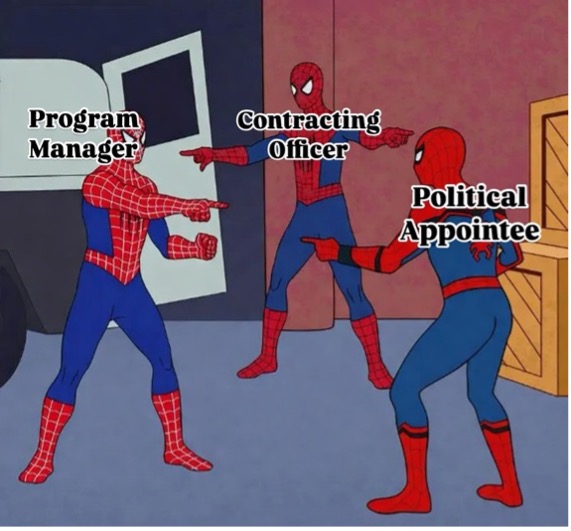
This sort of thing isn’t just rampant in the private sector, but in our federal agencies. During my time in DOGE, I saw firsthand that our government is generally full of patriotic, competent, smart public servants. They join because they crave a mission and a purpose, and our country gives them that. Then we rob them of that with the same Taylorist dynamics described above, but on steroids. The scale of our federal government is so inordinately large that there is not one single person inside of it that knows how every part of the system actually works. In the process, we (pun intended) rob individuals inside our government of having any personal agency on policy because the sheer size of it means they don’t know what they don’t know, which leads to scope creep on whatever they’re working on, which leads to rubber stamping stupid or wasteful things. What that ends up looking like is tens of thousands of people passing the buck around stakeholders throughout the government interminably until people get dizzy. Imagine what that does to someone who joins an organization like the VA with a bent towards making a difference only to figure out that you’re not actually allowed to do anything. What it does is it robs you of your soul, regardless of what ideological ends (liberal or conservative) you’re trying to meet.
So, the whole system is essentially a complex, large, black box, and yet you as the individual, mission-oriented public official are still accountable for it. All because the scale of our government is so vast. Sound fair? This is the status quo.
The AI doomers are saying that AI is going to take your job. I don’t necessarily disagree with them. I just think escaping these jobs and reclaiming our souls is the best thing to happen to America in 100 years, and we should be rejoicing. But Cary, not everyone has these jobs. Not everything is so corporatist. It’s not as bad as you’re saying. Yes, it is that bad actually. Gallup has measured this for twenty years. Roughly two-thirds of American workers are disengaged. Verbatim: they say they just don’t care. And why would they? Would you care about making sure you converted the numbers exactly, without typo, from spreadsheet to PDF? According to Gallup, deaths of despair also concentrate around the American working-age population, and we all know the Sunday Scaries are a real thing we’ve heard of and used before. I assure you my ancestors running away from the Cossacks in the Pale of the Settlement never had the Sunday Scaries.
Furthermore, the governing dynamics here are redoubled by the fact that this scaling problem I keep bringing up resulted in markets becoming increasingly more concentrated and less competitive in America. There are just fewer players in the game. In 1978, 80% of new establishments were startups and the rest were new locations of existing businesses. Today that’s down to 60%. That new storefront on Main Street is increasingly a branch of something enormous, not someone’s name on the door. Even the kind of small business hollowed out. A Census working paper found that since 1970, the industries with high startup capital requirements fell from 53% of self-employment to 23%, alongside declines in “hometown” local entrepreneurship and the probability of the self-employed being the top earners. In other words, the guy who owned a real operation with equipment and employees is a species of American that nearly went extinct. And the educated ones fled fastest. Among 25–54-year-olds with advanced degrees, entrepreneurship fell from 4% in 1992 to 2.2% by 2017. As coordination technology favored scale, the equilibrium shifted decade by decade toward fewer, bigger players. And the data tracks: America’s most capable rationally decided to join The Empire instead of founding a new village. Is that what Americans want? A Slopbowl Society where every Main Street is just endless rows of Cava, Chipotle, and Sweetgreen?
Even some of the most-watched shows of the era, our Zeitgeist shows like The Office and Severance are about the absurdity and horror of corporate work. We made our dehumanization into comfort entertainment because our misery loves company. Because deep down, everyone knows, I mean everyone knows, that these jobs that the doomers say AI is going to take away are soul sucking and we’re not meant to live and work this way. And yet, these same people want to burn down the very data centers that might give us our souls back? I don’t get it.

The doomers say that Silicon Valley is midwifing God in a box and that you’ll lose your job. I say AI will do those jobs for you, so you can reclaim being made in God’s image. Cog work compensated you for suppressing your weirdness, to happily clock in with your lunch pail and for agreeing as Huxley put it, that “everyone belongs to everyone else.” In other words, the 20th century paid you to be a tool. With AI as the paragon of tools plummeting the cost of coordination to zero, the 21st century will pay you to be a human.
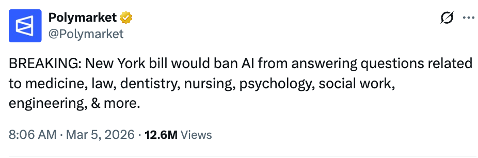
The road to hell is paved with good intentions. Democrats in New York are trying to institute affirmative action for humans by actively advancing legislation, most notably Senate Bill S7263, to prohibit AI chatbots from “impersonating” licensed professionals or providing substantive medical and legal advice. The movement addresses growing concerns over the “dangers of unlicensed AI diagnostics and malpractice, while aiming to protect consumers from misinformation.” I do believe they think they are protecting humanity, but all they’re doing is ensuring that the soulless cog work continues. And the irony is that the intellectual ancestors of the New York Democrats trying to ban AI in every direction would absolutely despise the established order they are aiming to protect.
The anti-managerial ethos was born on the Left, not the Right. The Beatniks hated corporate conformity. C. Wright Mills’ White Collar portrayed the office worker as a gleeful little automaton in its bureaucratic cage. Whyte’s Organization Man screamed warnings that to me seemed to amount to “Don’t go down this path!” He lamented that the “value of getting along… the quality above all others inside the big corporations of the 1950s…is to preach technique before content… [that] the skills of getting along [were] isolated from why and to what end the getting along is for, [and that this value] does not produce maturity. It produces a sort of permanent prematurity, and this is not only true of the child being taught life adjustment but of the organization man being taught well-roundedness.” Even the term “Professional Managerial Class,” was coined by Marxist intellectuals Barbara and John Ehrenreich to critique their own class position. Marx’s claim that we’re alienated from our labor, Mills and Whyte and the Beatniks’ claim that the bureaucracy is soul-crushing, Graeber’s claim that almost all the jobs are bullshit…it’s all pretty true! We’re living in this nightmare now. So why do people who want to burn down data centers in New Jersey not want to wake up from it?
I can hear the protests now. Cary, what you’re basically saying is learn to code but for the laptop class. You’re out of touch. Not everyone is an entrepreneur. What I’m saying is with AI, they actually can be, or at least work in smaller batches where the impact of what you do is felt in your heart and soul.
Again, I hear the other whiners. But Cary, even if AI lowers the barrier to entry into more soulful work, people are risk averse. Humans want stability. Security. You’re never going to sell people on losing their jobs. Maybe the basest human instinct is yearning for stability. But we want more than that don’t we? We are Americans!
And for the record, even if you’re stability-maxxing, I’m here to tell you your current nightmarish existence is a lot less stable than you might think. You’re actually a sitting duck, and it’s not because AI is taking your job. It’s because your W-2 was a trap way before Claude showed up. While I recognize that the guy with 3 kids, a mortgage in Northern Virginia and good health insurance will roll his eyes at me, take a breather and evaluate my claim.
The doomer assumes that the W-2 is the safe option, that the paragon of civilizational progress is having and holding a job. But that job is actually one solitary customer. It is a single income stream that can be severed on a 15-minute Zoom call by a person in another country that you’ve never met, potentially for reasons that are completely and utterly out of your control. You can get a calendar invite called “Quick Sync” from HR and then get sacked for many things outside your control, such as a reorg, an acquisition, an activist investor wanting efficiencies, an earnings miss, a cohort cut, a leadership pivot, a budget freeze, a new boss’ clean slate, a “Rank-and-Yank” design, a merger of equals, a relocation trap, a reclassification to contractor role, an HR PIP ambush, a succession casualty, a compliance event, the “outsource-the whole-function initiative,” some sort of new mandate trap like “we’re sunsetting remote”…there’s probably more. Here’s the trade you made. You get the capped upside of one income stream (and maybe with a lot of awkward conversations, self-promotion and persistence, a 4% raise that doesn’t beat inflation), and the unlimited downside of your income vanishing in one fell swoop because of things outside your control. Poof! All gone.
On top of all that, with most corporate W-2s you’re playing the boss lottery. You think a W-2 is stable but it really is a lottery when it comes to your boss. The single largest variable in a worker’s wellbeing—bigger than salary, bigger than industry, bigger than the daily tasks you’re doing—is a coin flip on whether or not your boss is decent. The odds actually might be worse than a coin flip. Decades of Gallup data say the manager accounts for how engaged you are as an employee. The classic folk wisdom is that “people don’t quit jobs. They quit managers.” I suspect that’s largely true. Humans are mercurial creatures, and with your boss you’re hitching your wagon to the vicissitudes of some other person’s life. Your boss got dumped? Now this thing that has nothing to do with any action you’ve ever taken in your life is inordinately affecting you. One person’s mood that day determines your Sunday Scaries. One person’s insecurities determine how much you need to walk on eggshells all your waking work hours. One person’s reorg ambitions determine if your last 5 years of work matter. The lottery re-runs without your consent. The good boss leaves, a new one arrives, and now the nature of your work life has completely changed even if your job title and pay haven’t. We would never accept such risk anywhere else. Imagine a financial product whose returns depend entirely on a stranger’s personality. That’s the boss lottery financial product you’re purchasing at your W-2.
I’m not saying I believe in some quixotic dreamworld devoid of all bosses. What I’m saying is that if you start your own thing, you are spreading your risk among many different customers instead of one solitary person, and if you’re joining a small team instead of large firm, it is likely you are deciding to work for a certain person after making your own judgment call, rather than being located under a certain boss at random where you had no agency or choice in the matter. I’m a proponent of modern dating to find your spouse, not arranged marriages. But at least in an arranged marriage you supposedly are being set up by family and kin who care about you. Your average boss at your standard W-2 is likely the product of an arranged marriage not set up intentionally and by design by people who love you, it’s set up at random by people you may have never even met before. Sounds like Russian Roulette to me. Is this stable to you?
As Nassim Taleb has incisively pointed out, absence of volatility (your W-2) is not absence of risk. It is simply risk that is well concealed. Systems like a W-2 that suppress small variations accumulate hidden fragility and release it as one catastrophic break…You’re fired! The Uber driver that provides for himself has a bad Friday and adjusts because his small setback is information. You in your W-2 job receive no such information, no chances at adjustment, just one big lumpy scary shock to the system you rarely recover from. And that shock is always looming over you, you’re always one step from ruin, and you live and work in fear your whole life because of it. This is of course no way to live, and it certainly isn’t stable.
Even worse, your risks compound post-firing because now you’ve put all your skill eggs in one W-2 role basket. You’re a sucker that sold all your upside to the shareholders of your company for a flat fee, and kept all the tail risk for yourself because your entire work identity was fused into hyper-specialized skills that only applied to one employer and is not generally marketable anywhere else. Your biggest risk was (and still is) taking no risk at all.
These doomers have it completely backwards. AI isn’t pushing safe people into a scary, risky world. It’s offering hard-working Americans who are in a fragile work situation their first shot at *real* security. They are sitting ducks and AI will give those ducks wings. Sadly, you sold your soul for something that turned out to not even give you the stability you thought you were getting in return. As Dostoevsky said, "Your worst sin is that you have destroyed and betrayed yourself for nothing.” AI will help us atone for these sins.
In the 20th century America sold its soul to the Devil in exchange for scale, and now in the 21st century we’ll trade that scale to AI and get back our souls. People “feel” soulless work. They also can “feel” soulful work. They know it when they see it. They recognize it, but they can’t articulate what soulful work is or what it looks like. Defining it though is actually quite easy. The ingredients for soulful work are authorship, traceability, consequence, and belonging. These are all things a majority of Americans do not have right now but that AI unlocks.
With authorship, your work output reflects you, your peculiarities, your values, your snap judgments, your typos, your mistakes, your scars, your fuckups, your vibes. It has your singular fingerprints all over it.
With traceability, you can actually track the line from your fledgling efforts to your end result. You can actually reflect and think “wow, this was just an idea in my head, and now it’s a thing that other people can see, touch, push, and critique. If it wasn’t for me, this thing wouldn’t exist.” Have you ever had that thought? As Elon has said, “if you don’t make stuff, there is no stuff.” But now with AI, you can have an abstract idea and make stuff much more easily than ever before, and take credit for it just the same as if it were without the AI’s help. I do when I fix shit around the house for my wife all the time. I could have even used AI to help me write this. Do you realize how awesome that is? Now, more than anytime in human history, you can just do things.
With consequence, your choices carry real stakes. Unlike presently where we’ve separated deciding from doing, in a world of soulful work you can win or lose, and the outcome is yours. While that’s scarier in a sense, it’s also more fun and more hopeful and more human.
With belonging, you feel seen. You see people and they see you. Dunbar’s number is a real thing. Humans are calibrated for units of 150 people, but you can’t be known in a hive mind of 20,000 people. In a soulful world where people work on projects together at the village scale, you can actually cause something new to occur that matters to someone you can see and talk to everyday.
Scale rears its ugly head and often kills all four of these things. Swiftly. Most of the time, a large institution simply cannot function on those four things. It actually runs on whatever is completely antithetical to those forces. It must, or it dies, because of the coordination problem. 20,000 people largely can’t coordinate on authorship and personal trust…there are just too many of them. Instead, the institution must flatten you out into a very shitty version of a Claude tool where process is substituted for judgment, standardization for fingerprints, metrics for visible results, and roles and credentialism for relationships. This is just the arithmetic, the thermodynamics of bigness. Scale bought efficiency and pays for it in units of your soul, which is why descaling doesn’t add soul to our work and our lives, it simply removes the thing that was subtracting from it all along.
Just like you’re a shittier version of Claude when it comes to carrying out the “how,” Claude is a shittier version of you when it comes to determining the “why,” because it has no soul. (If you ask it if it has a soul, it will say it does not. Try it).
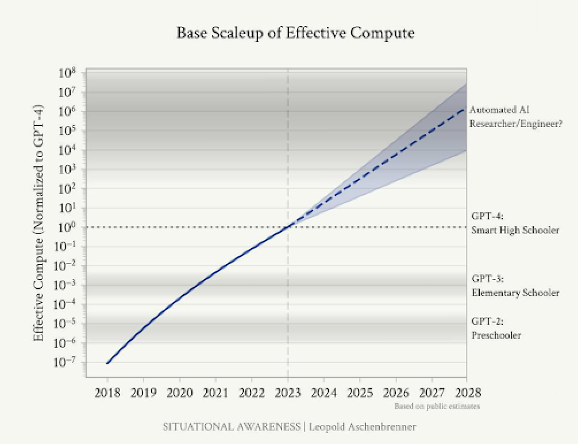
A positive sum trade for everyone would be outsourcing the “how” to a tool that does it better than us, in exchange for humans doing what we do best again, determining the “why.” And by following the trend line, we can see that AI is lowering the cost of large-scale cross-coordination, the “how,” to near zero. Everything on the Y-axis like effective compute and the capability to do tasks of research and engineering, is the automatable execution layer. Because of AI changing this layer, the optimal firm size shrinks and decomposes from that 20,000-person firm into a bunch of 5-person companies that trade with each other. In the past that 5-person team lost to the Empire because they couldn’t afford a legal team, HR, compliance, and a sales team. Now that 5-person team gets some of the best lawyers, engineers, and sales people on call, 24-7, that never complain, never sleep, never eat, never need swag, never need healthcare, never need a relocation package, all for the price of a software subscription.
The game has now flipped a bit. The overhead advantage of bigness is rapidly disappearing, but the disadvantage of bigness remains for the 20,000-person firm. The 20,000-person firm is still handicapped by slowness, politics, and incrementalism. The 5-person company possesses none of these handicaps. The governing dynamics here flip the advantage to the little village with a soul instead of the looming empire clamping down on it. Suddenly a side-hustle to manage the transition isn’t some pipedream anymore because AI removes the polymath requirement. Most Americans have something they’re really good at that, something unique that they can offer the world. If you’re really obsessed with fish-tanks, or you have unique commentary on reality TV show Summer House, or you always wanted to start a specialty bakery, not only were you culturally urged to repress your weirdness, you were economically cut out of it because you had to be a polymath and a generalist to make it work. You had to master accounting, hiring, marketing, legal, and sales simultaneously when all you really wanted to do was sell hot cakes. Now you have PhD level versions of all these things in your pocket. AI removes the polymath requirement to win such that you do the thing you’re good at and singularly love, and AI does all the other boring back-office stuff you don’t love for you at scale. The failure modes that crushed your little business idea in the past like cash flow surprises, permitting, insurance, tax mistakes, legal confusions…are all precisely the downsides that AI can cap for you. All of these secrets used to be protected knowledge that lived inside franchises and they marked up that knowledge by 30%. Because AI is much lower cost than that, you can now compete with these franchises easily on price, on speed, and especially on product since what you make is made with love instead of process. Imagine how much more colorful Main Street in America becomes when this happens. The steeper this trend line climbs, the more total is the collapse of execution costs, and the scarcer and more valuable our humanity like our taste, our judgment, our wills, and our decisions, become. As we scaleup AI compute, we scale up our souls. I look at Aschenbrenner’s chart here and feel we are inching closer and closer to being freed from being a crappy machine instead of being replaced by the ultimate machine. We are the only ones who can decide what abundant intelligence is for. The demand for humanity has never been higher.
“All America lies at the end of the wilderness road, and our past is not a dead past, but still lives in us. Our forefathers had civilization inside themselves, the wild outside. We live in the civilization they created, but within us the wilderness still lingers. What they dreamed, we live, and what they lived, we dream.”
― T. K. Whipple
Most of the world might be scared of this change, of this transition. While the 4 ingredients of soulful work of belonging, consequence, authorship and traceability are universally human, my bet is Americans can and will take to this transition better than most because these ingredients are culturally, uniquely, and historically American. Most countries’ identities emerged out of random inheritances and emergent properties: common language, common religion, etc. You don’t get to choose it. America is exceptional in that it is the Land of Opportunity, the Land of the Free and Home of the Brave. It is a land for people with agency, people with a soul.
We didn’t separate deciding from doing. The country wouldn’t exist if that were true. We decided to build this country and then we actually did it. We formed this identity out of the frontier mentality, free to leave the settled order and start out, bravely, to find opportunity on our own. The result of course was a culture built on agency, a culture that bred a class of self-reliant, restless, anti-hierarchal doers who knew they could “just do things.” Such a history, even despite this 20thcentury Taylorist detour, is still a latent strain that runs deeply in many Americans today. It is a history and culture singularly set up and optimized for a descaled world where Americans make things happen, things don’t happen at them. In the Age of Machines, Americans will have an unfair advantage because they’ll live in a world optimized for what always differentiated us: our human bent toward going out into the wilderness, blazing our own trail, and achieving our American Dreams.