
American Intelligence
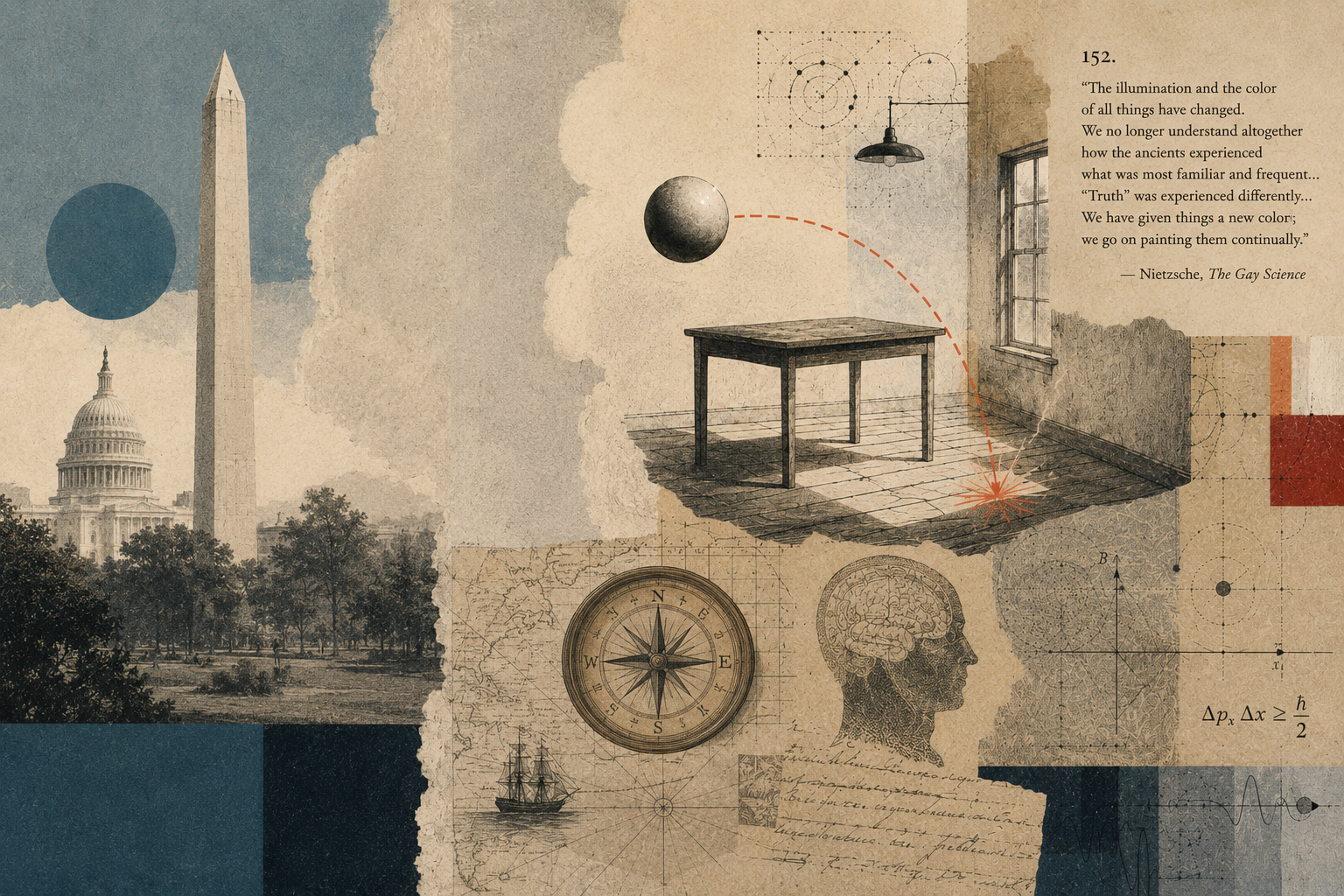
We’re sitting on a bus in DC when Ivan tells me to close my eyes. “Picture it,” he says. “A room with a table. Onto the table drops a ball. The ball rolls. Falls. Hits the ground.” He tells me to open my eyes. “What color’s the ball?”
I hesitate. Ivan is not only seriously sharp, he’s a little sly. The sort of person who makes me feel like maybe he is constantly assessing me, like he has some mental compendium of his impressions and shifting estimation of those around him. I want to know what he’s after.
“Why would it have a color? It’s just the concept of a ball, so… there is no color?” my inflection lifts at the end, like I want to pass his test.
“Hm.” I read intrigue, a hint of approval on his face. “So you have it too.” The start of a grin as he says, “Aphantasia.”
That’s the moment I realized that when people speak of the mind’s eye, they don't mean it in a theoretical way. That, when prompted to picture a table in a room, most people conjure a visual. There is texture, light. Decor. For me, it’s more Platonic form–all idea, no image.
And really, it’s shocking it took me 34 years to figure this out. When I was a girl with an upset stomach or skinned knee, my dad would ask me to visualize the pain. What color is it? What shape? How is it changing? I always thought we were talking about a notion of pain, figuring and transfiguring it abstractly. Then there’s the fact that my sister would disparage casting choices in movie adaptations of books we’d read. I thought it strange she had an opinion on how a given character should look. As far as fidelity to the text goes, I’ve always cared more about how well a movie translates what I love best in literature—interiority, the proximity to another’s consciousness—to the visual, plot-driven medium of film.
I spent the better part of my twenties reading everything David Foster Wallace wrote and wondering of others, what is it like inside your head? I felt compulsively curious, yearning for but unconvinced of the possibility of ever truly knowing another—how they think and feel, what they believe.
The consequent shock of it, this gap between attentive effort and actual understanding. To have spent years of obsessive delving into the peculiarities of my mind, only to miss something so fundamental. And when the recognition comes, it comes epiphantically: I am an unreliable witness to my own perception.
Cue the cascading questions: If I can’t know my own brain, then what is the nature of this “attention” I’m bestowing? What else might I miss for want of the right test, the right instrument? And what sort of instrument could there be anyway for detecting or comparing the disparate experiences of inhabiting consciousness?
At the same time, on some level, I already knew this. The perspectival nature of truth. It’s at the core of Nietzsche, the thinker who so transfixed me after my David Foster Wallace phase. Excerpts of his aphorism 152 in The Gay Science read:
The illumination and the color of all things have changed. We no longer understand altogether how the ancients experienced what was most familiar and frequent… “Truth” was experienced differently… We have given things a new color; we go on painting them continually.
Nietzsche invites us to maintain a receptivity to forever revising our interpretations. This receptivity allows us to look back to our prior understanding and recognize “Truth” as a mutable thing. We paint, perpetually, even as we forget the brush in our own hand.
In quantum mechanics, the act of measuring a particle’s position necessarily disturbs its momentum. You simply cannot observe the system without becoming part of it. It’s the classic double-slit experiment: to observe is to partake and alter. There is no position of pure witness. Our instruments participate in producing the result.
It’s been half a year since Ivan revealed that quirk of my mind to me. In the intervening months, we’ve had long, wide-ranging conversations on his AI research and what it means for people—not just the workforce or economy, but for our self-knowledge, our souls, our societal aims. I tell him how haunted I’ve been by the abrupt, retroactive vertigo his aphantasia test ushered in and how I see in it something akin to the precipitous perspective shift we are about to experience, are already experiencing, in the age of AI.
“Yes,” he affirms, “you’ve been alive 34 years. And then you realize this. How can you come to the conclusion that your conscious experience is so different, after so much time? It connects to the shock for us all in what’s about to happen. Even though you’re here, you’re present, you’re reading the news. It’s still going to be astonishing.”
We have a steady historical rhythm with respect to technology: alarm followed by adoption, adaptation, and (generally speaking) prosperity. The fearmongering, the handwringing—it’s nothing new. It’s Plato’s lament that the written word imperils man’s memory, lulling our minds into passive reliance. It’s the printing press’ promise to upend established authority via mass dissemination. It’s Walter Benjamin’s elegy for the aura of art, the unreproducible presence of the original, dissolving in the age of mechanical reproduction. Which isn’t to dismiss the concerns. The oral tradition, which now strikes us as romantically anachronistic, has all but disappeared. Our political, religious, and social consciousness remains wrought by pamphleteers and their revolutionary ideas—Martin Luther, Thomas Paine, Marat, Marx and Engels, Chernyshevsky, Hamilton and Madison and Jay, take your pick. As for Benjamin, how he would flummox in the face of our digital photographic and cinematic capabilities!
But this is the world we inhabit. Railroads gave way to highways. Telegraphs to telephones to cellphones. With time, the terror of transition fades. We are, individually and collectively, above all, resilient.
For me, the nineties and early aughts feel a cultural pinnacle—technological assistance without the totalizing psychic dominance of smartphones. Perhaps we all reach to the decades of our youth, cast as they are in the rosy, quixotic light of childhood. When I think back, I don’t turn to Columbine or the Patriot Act, the dot-com bubble or the Great Recession. Even the most era-defining tumult, like 9/11 and the War on Terror, is simplified, dimmed. And this is disruption I lived through. The Soviet Union dissolved the year I was born. I didn’t experience Cold War bomb drills, wasn’t told to crouch beneath my desk, so I don’t endow that period with the full, vivid panic I might have felt as an eight-year-old, burying face into chest to brace for nuclear fallout. Instead, I remember the stroke of midnight, Y2K, when we held a collective breath—visions of colliding airplanes, industrial accidents, and power grid failures receding—then raised a glass (Martinelli’s for me) to a vibrant future.
What I’m trying to say is: we know the pattern. Fear. Adjustment. Net positive (and, yes, maybe positive is accompanied by scare quotes or an asterisk). But, be it the printing press or Y2K, we also know how these stories end. Invariably, that resolution colors our sense of events. There’s a temptation to assume that current uncertainty will resolve just as past uncertainty has resolved. That the rate of change and our capacity to adapt will hold just as it has held.
I’ve been immersing myself in the whole gamut of takes regarding AI. The doomers, the skeptics, the accelerationists. There’s a lot of hype, a lot of hyperbole. See: If Anyone Builds It, Everyone Dies. And I get it, the desire to convey the gravity in an attention economy where your audience is more likely to register titles and tweets than to read the entire article or book. If AI’s advancements fit the pattern, this catastrophizing will fade, another relic to join the ranks of Cold War duck and cover drills.
Ivan assures me, “this pattern is real and should be taken seriously.” But he continues, "The turkey wakes up every morning, he gets fed. And he goes on and on and on for three hundred and sixty four days. And then, the day before Thanksgiving, he's expecting to be fed. And he isn't."
The pattern is real. The pattern is also not a guarantee.
As an investor in startups at the forefront of technology, Ivan’s witnessed the vertiginous pace of advancement. He’s been casually recording his observations on a blog, where his posts bear titles like “AI is Overhyped and Underhyped.” His writing is incisive and sobering, especially when he’s opining on the relative lack of appreciation the public has for the changes underway:
If god-like aliens were known to arrive in 20 years, world governments would be fervently preparing for unprecedented civilizational change. And yet, we are barely considering that risk because AI is a homemade alien made of silicon instead of a green extraterrestrial being.
Maybe. The difficulty of grasping the ramifications in store may be due, in part, to the fact that AI isn’t an external threat. We built it ourselves. But so too did we build the atomic bomb. And maybe we needed that devastating manifestation of the weapon’s actuality, not just its potential, to start treating nukes with the urgency they demand. That said, despite most Manhattan Project physicists’ opposition, Teller and von Neumann still produced the hydrogen bomb. Plus, I’m not convinced that the Cold War strategy of MAD (informed, as it turns out, by Morgenstern and von Neumann’s seminal work on game theory) evinces the delicacy or urgency Ivan’s suggesting. I will grant, though, that we appear better equipped to undertake strategic planning, marshaling resources and exploring existential risk, when the danger is other—external, outside.
You see, the trouble for Ivan’s turkey is that it is of the system. Inside. The farm is the only reality it knows. 364 days of solid data, but such is the condition of being inside. No amount of intelligence or attention can solve for that pesky structural constraint. The same goes for us, amid the AI transformation, watching as technology remakes our world, shaped by and participating in it. Our attention, anxiety, and hopes. The changes settle in, vague, near-imperceptible, but they keep coming at us, rapid-fire. There is no outside.
Despite my analogies to extraterrestrials and nuclear war, what I find most unsettling is not the potential dangers of AI, but how familiarity has anesthetized our sense of scale. This familiarity surely stems from our resilience, a noble faculty, and from our position within the system, a constraint we cannot escape. But I fear it induces myopia as we grapple to comprehend and control the ever-extending technological frontier.
Apple introduced the iPhone in 2007 and the App Store in 2008. The most popular downloads in the early years included the flashlight and iBeer, which enabled you to simulate drinking a beer by tipping the phone as you would a pint glass, complete with digitally-sloshing foam and sound effects. Of course, the iPhone was also practical. Google Maps, which launched in 2005, was among the dozen or so pre-installed apps, immediately replacing the need to print off MapQuest directions. We understood the iPhone through the lens of the computer, so we thought of the device as a portable approximation of a desktop or laptop’s basic functionality. The first order effect was all novelty and convenience.
As an undergrad, 2009-2012, I carry around a point-and-shoot camera and upload photos to a hard drive via USB. Post-college, I download Instagram to edit photos for a Facebook that is still a social network—I post entire albums of pictures and write on friends’ walls, my feed filled with friends’ chronological updates—not yet the algorithm-driven social media of today. Google Maps no longer simply aids navigation, it serves as the primary way to discover local businesses. Yelp expands, the review economy emerges. Businesses live and die by stars. Meanwhile, GPS and real-time location enable Uber’s emergence. The car, a personal possession, turns commercial asset. One’s idle time, inventory. Lyft, Airbnb, Doordash. 2014 welcomes UberEats and Slack. When Steve Jobs debuted the iPhone, none could anticipate the gig economy, the dissolution between work and rest, or the pervasive presence of our phones. The changes came subtly, accumulating. The second order alters the texture of daily life.
I tend to reach for the word obliterative when describing my late teens to mid-twenties. Within the span of a few years, I’d held my father, then my mother, as they slipped from me. Cancer. Further personal catastrophes followed and I grew unmoored from my life. When all I could do was walk for hours through Boston listening to an audiobook, I wished for some external sign of mourning I could don, simply to excuse the extreme antisocial behavior I knew I was exhibiting by wearing headphones in public. These days, on the train, resisting the allure of my phone’s ready entertainment and information, I scan the crowds of commuters to see whether I can clock a single person neither scrolling nor listening to something in their headphones. Occasionally I see a parent tending to children or someone reading a book, but often not. It is only when I juxtapose the discrete memory I have from 2017, my year in Boston, that I appreciate just how radically our daily lives have changed. The third order? I don’t yet know. We’re still inside it.
My conversations with Ivan, often facilitated by video calls and AI transcription, take on a burgeoning breadth. This mode of communication and brainstorming surfaces a real tension. It is remarkably helpful for me (quite excitable and prone to free-association) to jump among observations and references, all muddled together and half-formed, knowing that I’ll receive the text of our talk verbatim along with an overview organized into coherence. The desire for such assistance threatens to drift further into my daily life. When I’m spending time with someone, I do my best to avoid taking out my phone, which means that details, recommendations, and plans slip my mind. How convenient it would be to reference notes and reminders after an interaction, as I do for my calls with Ivan. I see the benefit. The cost? It’s slippery. Where everything is reducible and everything is content, everything bends toward optimization. In the ever-optimized world, what happens to our capacity to be present or bear witness to our lives?
“The 2028 Global Intelligence Crisis” from Citrini Research, which recently caught fire, got me thinking about friction. I worry that the logic of the SaaS industry, built on the promise of removing friction, pervades beyond business, into commutes and calendars, dating, and even mourning. Friction-reduction has grown ubiquitous, ambiently present, this promise of less resistance, more ease. More time! And sure, there’s a whole tangent worth pursuing on how we are choosing to fill that time and whether it is actually enriching our lives, but I want to focus on something more primary: what if in friction we find our humanity?
As the mother of an 18 month-old, my days are defined by inefficiency. The very inefficiency Sam Altman recently joked about, rather inelegantly, when arguing that the energy required to “train” a human was considerably higher (20 years of life to live, food to consume, education to undergo) than that demanded by even the most voracious of AI models. From a certain vantage, he’s right. It would be laughable to quantify the time I spend sitting on the floor, reading the same books over and over, stacking the blocks to see them knocked down to stack them back again. And have you ever seen a toddler feed herself? But what makes us bristle about the joke is its disregard for the agony and ecstasy and even the banality, the ineffable humanness of life. The experience of motherhood stubbornly resists optimization and quantification. It demands of me that I slow down and linger and therein I discover the most human thing—witnessing the gradual emergence of my daughter’s curiosity and capacity, her personality and preferences, her moods and expressions and delight. There’s plenty we could do to make this process more efficient, but in so doing, we would jeopardize precisely what makes it profound.
If you’ve ever found yourself in the “trying to conceive” phase, perhaps you’re familiar with the frustrating patience it asks of you, even if only for a month or two. You can make every plan, can chart the ideal window, you can even buy a whole bevy of monitors and tests to measure hormones or motility and morphology, but at the end of the day, you wait. A friend of mine called it “half pregnant,” the two weeks or so after ovulation but before confirmation. The little tweaks you might make—no alcohol, of course, but also no sauna or hot tubs, and take the prenatal vitamins, mind your nutrition, get some extra sleep, just in case. I found my anxious energy during this phase curious and tried to probe it. I wasn’t worried that conception wouldn’t happen. For me, I realized, the discomfort was in the not-knowing. I hated waiting for the answer.
I wonder whether this impatience is a particularly modern condition. Take a modest example: a few decades ago, I might watch a movie and recognize an actor I couldn’t place or get the melody of a song stuck in my head while the words escaped me. The knowledge was right there, just beyond my recall. Maybe I’d ask a friend if she’d seen the film or hum the song for my dad. Maybe it would come to me days later, a revelation in the shower or out walking the dog, my mind on other things. Maybe it would simply slip from my thoughts, unsolved. That was fine too. I didn’t require an answer, and certainly not on the spot. It seems a small thing, now, to reach for my phone and search. How could there be any harm in it? But what if these habits have conditioned me, are conditioning me, my expectations of immediacy and resolution extending beyond mere knowledge retrieval?
Seeking to quell the sense of hurry in her life, a stay-at-home mom I know experimented with deleting the web browser from her phone. A group of us were reading a contemporary Christian book on the need for prayerful stillness and rest, and this was one among its many suggestions. Sometimes when I see her at church, I ask if she’s re-downloaded Safari. She has not. I am in awe. I make excuses, maybe if I didn’t have a job… but it’s cope and I know it. The truth is, I’m not sure I could function. Sure, I can forgo googling an actor’s name or song lyrics, but to remove the browser functionality entirely? To borrow an internet neologism, I have too many tabs open in my brain.
As we shed our instinct for sitting in unanswered questions, do we cultivate a certain intolerance for the unresolved, the not-yet-known? The possibility disturbs me, for what is the human condition but the steady pursuit of unanswerable questions and ever-unfolding horizons? I was stunned dumb by the opening line of Aristotle’s Metaphysics the first time I read it: Pantes anthrōpoi tou eidenai oregontai phusei. All men by nature desire to know. I’ve always struggled to endow the ancient worlds of Athens or Jerusalem with their due vibrancy, but in that moment, the distance collapsed. The verb, ὀρέγονται, translated as “desire,” conveys a sense of striving that actively reaches toward, stretching after its object, εἰδέναι, “knowledge” or “to know.” It is not a verb of possession or retrieval. There’s something yearning and restless about it, almost unrequited. What happens to this desire if we instinctively, instantly sate our wondering with the easy answer technology promises?
I’m not sure. I don’t think any of us are. And so, about once a week, I hop on a Google Meet to chat with Ivan, to continue to try to process what I encounter in the headlines and metabolize his technical perspective alongside my own musings. “One day we’re gonna have the epiphany: shit, this is what happened, but we’re gonna be on the other side of it” he tells me. So we all sit, in the middle of it, attempting to figure this rapid world into coherence.